


Moss in your lawn can transform a lush green carpet into a patchy, spongy eyesore. This persistent invader thrives where grass struggles, creating an uneven surface that compromises the aesthetic appeal of your garden. While many homeowners view moss as merely unsightly, its presence signals underlying problems with soil conditions, drainage, or lawn care practices. Addressing moss effectively requires understanding its causes and implementing targeted solutions that not only remove existing growth but also prevent future colonisation. With the right approach, you can reclaim your lawn and restore it to its former glory.
Understanding why moss invades your lawn
Moss flourishes in conditions where grass finds it difficult to thrive, making it essential to identify the root causes of its appearance. Unlike grass, moss lacks a proper root system and instead absorbs moisture and nutrients directly through its leaves, allowing it to prosper in environments that would challenge traditional turf.
Common environmental factors favouring moss growth
Several environmental conditions create the perfect breeding ground for moss proliferation. Poor drainage stands as one of the primary culprits, as waterlogged soil provides the constant moisture moss requires. Compacted soil exacerbates this issue by preventing proper water infiltration and limiting oxygen availability to grass roots. Additionally, excessive shade from trees, buildings, or fences reduces sunlight exposure, weakening grass whilst moss thrives in low-light conditions.
- Acidic soil with a pH below 6.0
- Poor air circulation in sheltered areas
- Low soil fertility and nutrient deficiencies
- Thin or sparse grass coverage
- Excessive thatch accumulation
How soil conditions contribute to moss development
The chemical composition of your soil plays a crucial role in determining whether moss will establish itself. Acidic soils create an inhospitable environment for grass whilst providing ideal conditions for moss. Nutrient-poor soil weakens grass, reducing its competitive advantage and leaving bare patches where moss can colonise. Compaction further compounds these issues by restricting root development and creating surface water pooling.
Recognising these underlying conditions allows you to address the problem strategically rather than simply treating the symptoms. With this knowledge in hand, you can now explore practical solutions to eliminate existing moss from your lawn.
Natural methods to eliminate moss
Removing moss without resorting to harsh chemicals offers an environmentally friendly approach that protects beneficial organisms in your soil whilst effectively tackling the problem. These methods require more physical effort but provide satisfying results without introducing potentially harmful substances into your garden ecosystem.
Manual removal techniques
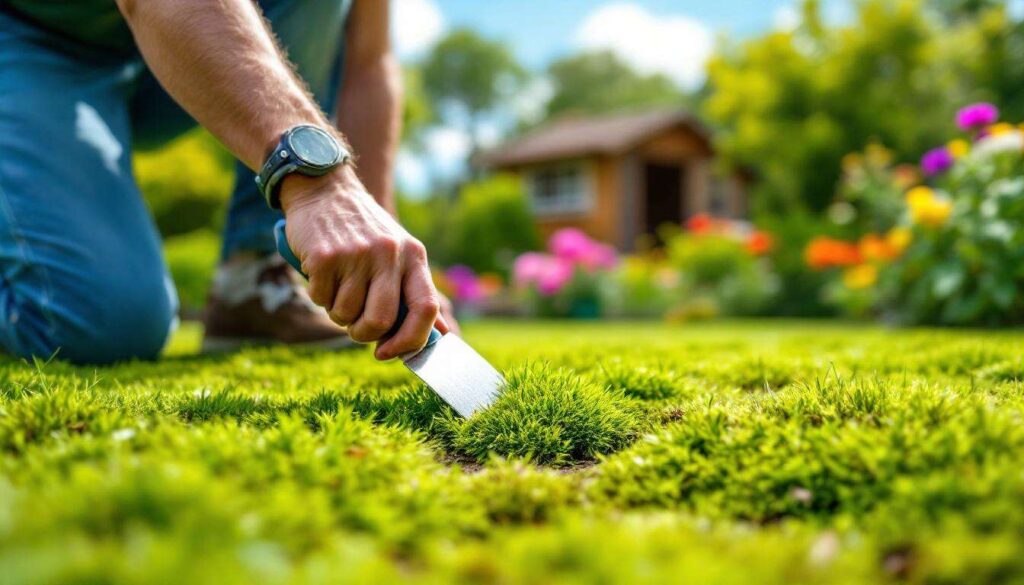
Physical removal represents the most straightforward approach to dealing with moss. Scarification, or vigorous raking with a spring-tine rake, pulls moss from the soil surface. This labour-intensive method works best on small to medium-sized lawns and provides immediate visible results. For larger areas, a mechanical scarifier or dethatching machine can significantly reduce the workload whilst achieving thorough moss removal.
After scarification, collect and dispose of the removed moss rather than leaving it on the lawn, as fragments can re-establish themselves if conditions remain favourable. The process typically leaves the lawn looking worse before it improves, but grass quickly fills in the disturbed areas with proper care.
Natural moss-killing solutions
Several household substances can effectively kill moss without synthetic chemicals. Baking soda scattered over moss-affected areas raises the pH locally, creating conditions unfavourable for moss survival. Apply approximately 3 tablespoons per square metre, then water lightly to activate the treatment. The moss should turn brown within days, indicating successful treatment.
| Natural Treatment | Application Rate | Effectiveness Timeline |
|---|---|---|
| Baking soda | 3 tbsp per m² | 3-5 days |
| Dish soap solution | 60ml per 8 litres water | 24-48 hours |
| Vinegar spray | Undiluted application | 2-3 days |
These natural approaches prove effective for immediate moss control, but for persistent problems or large infestations, homeowners sometimes require more powerful interventions.
Using chemical anti-moss products
Chemical moss killers offer rapid and comprehensive control when natural methods prove insufficient or when dealing with extensive moss coverage. These products contain active ingredients specifically formulated to target moss whilst minimising harm to grass.
Types of chemical moss treatments available
The market offers various formulations designed for different application preferences and lawn conditions. Ferrous sulphate remains the most common active ingredient in moss killers, working by desiccating moss tissue whilst simultaneously providing iron nutrition to grass. Combination products often include fertiliser alongside moss killer, addressing nutrient deficiencies whilst eliminating moss in a single application.
- Liquid concentrates for spray application
- Granular formulations for spreader distribution
- Ready-to-use spray bottles for spot treatment
- Combination feed and moss killer products
Application guidelines and safety considerations
Proper application timing and technique maximise effectiveness whilst minimising environmental impact. Apply moss killers during mild, dry weather when rain is not forecast for at least 48 hours. This allows the product to work without being washed away prematurely. Always follow manufacturer instructions regarding application rates, as over-application can damage grass and contaminate water sources.
Wear protective equipment including gloves and eye protection when handling chemical products. Keep children and pets off treated areas until the product has dried completely or as specified on the label. After the moss has blackened and died, typically within two weeks, rake it out thoroughly before overseeding bare patches.
Successfully eliminating moss represents only half the battle; maintaining a moss-free lawn requires ongoing attention to prevent its return.
Preventing the return of moss with regular maintenance
Establishing a consistent maintenance routine creates conditions that favour grass over moss, making your lawn naturally resistant to future invasions. Prevention proves far easier than repeatedly treating moss outbreaks.
Essential lawn care practices
Regular mowing at the correct height strengthens grass and increases its competitive advantage. Most lawn grasses perform best when maintained at 2.5 to 4 centimetres, though this varies by species. Cutting too short weakens grass and allows moss to establish more easily. Sharp mower blades ensure clean cuts that heal quickly, reducing stress on grass plants.
Aeration addresses soil compaction by creating channels for air, water, and nutrients to penetrate the root zone. Annual aeration in autumn using a hollow-tine aerator removes soil cores, significantly improving drainage and reducing waterlogging that favours moss. For heavily compacted areas, twice-yearly aeration may prove beneficial.
Seasonal maintenance schedule
| Season | Key Maintenance Tasks | Frequency |
|---|---|---|
| Spring | Scarification, fertilisation, overseeding | Once |
| Summer | Regular mowing, watering during drought | Weekly/as needed |
| Autumn | Aeration, autumn fertiliser, leaf removal | Once |
| Winter | Avoid foot traffic, remove debris | As needed |
Consistent maintenance creates resilient turf, but optimising the fundamental growing conditions provides the foundation for long-term success.
Improving the growing conditions of your lawn
Modifying the underlying environmental factors that favour moss creates a sustainable solution that addresses the problem at its source rather than merely treating symptoms repeatedly.
Soil pH adjustment and fertilisation
Testing your soil pH provides crucial information for creating optimal growing conditions. Most grasses prefer a pH between 6.0 and 7.0, whilst moss thrives in acidic conditions below 6.0. Apply ground limestone to raise pH gradually, following soil test recommendations for application rates. This process takes several months to complete, so patience proves essential.
Regular fertilisation strengthens grass and improves its ability to outcompete moss. Apply a balanced lawn fertiliser in spring and autumn, choosing formulations appropriate for your grass type. Slow-release fertilisers provide sustained nutrition without promoting excessive growth that requires frequent mowing.
Addressing drainage and shade issues
Poor drainage requires structural solutions for permanent improvement. Installing drainage systems, creating gentle slopes away from problem areas, or incorporating organic matter to improve soil structure all contribute to better water management. In persistently waterlogged areas, consider creating bog gardens or selecting plants adapted to wet conditions rather than continuing to fight nature.
- Prune overhanging branches to increase light penetration
- Consider shade-tolerant grass varieties for shaded areas
- Install French drains in chronically wet locations
- Incorporate coarse sand into heavy clay soils
- Grade surfaces to prevent water pooling
For areas with excessive shade where grass struggles despite best efforts, alternative ground covers such as shade-tolerant ornamental plants may prove more practical than maintaining a traditional lawn.
Successfully banishing moss from your lawn requires a multifaceted approach combining immediate removal with long-term environmental improvements. Understanding the conditions that favour moss allows you to address root causes rather than repeatedly treating symptoms. Whether choosing natural or chemical removal methods, thorough elimination of existing moss provides a clean slate for recovery. Regular maintenance practices including proper mowing, aeration, and fertilisation create conditions where grass thrives and moss struggles. By adjusting soil pH, improving drainage, and managing shade, you establish a sustainable lawn ecosystem naturally resistant to moss invasion. With patience and consistent care, your lawn can transform from a moss-riddled disappointment into the verdant carpet you envisioned.