
Leaving for three weeks without worrying about your houseplants or garden might sound like an impossible dream for many plant enthusiasts. The fear of returning to wilted leaves and dried-out soil often overshadows holiday excitement. Yet there exists a remarkably straightforward solution that requires neither expensive automated systems nor the goodwill of neighbours who might forget their watering duties. This simple watering hack has proven effective for countless gardeners, allowing them to enjoy extended breaks whilst their plants remain healthy and hydrated throughout their absence.
The importance of watering during holidays
Understanding plant water requirements
Plants rely on consistent moisture levels to maintain their cellular functions and photosynthesis processes. During a three-week absence, most houseplants and garden specimens will experience severe dehydration without intervention. The consequences extend beyond mere wilting: prolonged drought stress can trigger irreversible damage to root systems, leaf structures, and overall plant vitality. Different species have varying tolerance levels, but few can survive three weeks without water during warmer months.
The risks of inadequate holiday watering
Neglecting proper watering arrangements during extended holidays creates several problems:
- Permanent leaf drop and browning that persists even after resuming normal care
- Root death that prevents the plant from absorbing water effectively upon return
- Increased susceptibility to pests and diseases in weakened plants
- Complete plant loss, particularly for moisture-loving species
- Soil becoming hydrophobic, making rehydration extremely difficult
The financial and emotional investment in cultivating a thriving plant collection makes prevention essential. Understanding these risks highlights why implementing a reliable watering system before departure isn’t merely convenient but absolutely necessary for plant survival.
How to prepare your plants before leaving
Assessing individual plant needs
Before implementing any watering solution, conduct a thorough assessment of your plants’ specific requirements. Group plants according to their water needs: high-maintenance tropical species, moderate-requirement houseplants, and drought-tolerant succulents. This categorisation allows for tailored watering strategies rather than a one-size-fits-all approach that might overwater some specimens whilst underwatering others.
Pre-departure plant care routine
Several days before leaving, begin preparing your plants for the extended period ahead:
- Water all plants thoroughly to ensure soil is evenly moist throughout
- Remove any dead or dying foliage that might rot and encourage disease
- Move plants away from direct sunlight to reduce water consumption
- Group plants together to create a humid microclimate
- Apply a layer of mulch to soil surfaces to minimise evaporation
Strategic plant positioning
Relocating plants to appropriate locations significantly reduces water loss. Move them to cooler, shadier spots within your home, avoiding south-facing windows where intense sunlight accelerates moisture depletion. Bathrooms often provide ideal temporary homes due to higher humidity levels. For outdoor plants, consider moving containers to sheltered areas protected from wind and direct sun exposure.
With plants properly positioned and prepared, the foundation is set for implementing an effective self-watering system that maintains moisture levels throughout the holiday period.
Using a homemade drip system
The bottle drip method explained
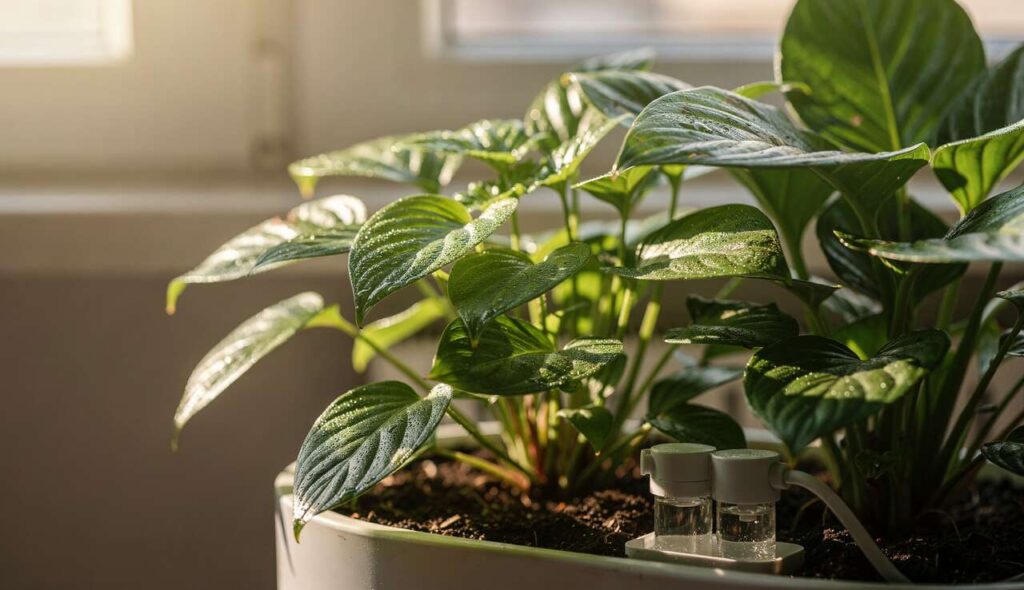
This remarkably simple technique requires only plastic bottles and basic household tools. Fill clean plastic bottles with water, pierce small holes in the caps using a needle or pin, and invert them into the soil. The water slowly seeps out, providing continuous moisture directly to the root zone. Bottle size should correspond to pot size: small bottles for compact pots, larger two-litre bottles for substantial containers.
Setting up the system correctly
Proper installation ensures optimal performance:
| Pot diameter | Bottle size | Number of holes | Expected duration |
|---|---|---|---|
| 10-15 cm | 500 ml | 1-2 holes | 5-7 days |
| 20-25 cm | 1 litre | 2-3 holes | 10-14 days |
| 30+ cm | 2 litres | 3-4 holes | 14-21 days |
Insert bottles approximately 5-8 centimetres into the soil at a slight angle, ensuring stability. Test the system several days before departure to verify the drip rate: soil should remain consistently moist without becoming waterlogged. Adjust hole size if water flows too quickly or slowly.
Whilst the bottle method works excellently for individual containers, those seeking to water multiple plants simultaneously might benefit from exploring alternative approaches that distribute moisture more broadly.
Benefits of capillary watering
Understanding capillary action principles
Capillary watering exploits natural water movement through porous materials. By placing plant pots on water-saturated fabric or matting connected to a water reservoir, moisture travels upwards through drainage holes into the soil. This passive system requires no electricity, timers, or complex mechanisms, making it exceptionally reliable for extended absences.
Setting up a capillary watering system
Implementation involves straightforward steps accessible to any gardener. Place a large tray or shallow container filled with water on a stable surface. Lay capillary matting or thick towels across the tray, ensuring one end remains submerged whilst the rest provides a platform for plant pots. Position plants directly onto the matting, confirming good contact between pot drainage holes and the moist surface.
Advantages over other methods
Capillary watering offers distinct benefits:
- Plants draw only the moisture they require, preventing overwatering
- Multiple plants can be watered from a single reservoir
- No risk of bottle tips falling over or holes becoming blocked
- Particularly effective for seedlings and moisture-sensitive species
- Scalable system suitable for small collections or entire greenhouses
The self-regulating nature of capillary systems provides peace of mind that plants receive appropriate moisture levels throughout the holiday period. However, even the most effective systems can fail if certain common mistakes occur during setup.
Some mistakes to avoid when setting up
Overcomplicating the solution
Many gardeners fall into the trap of creating unnecessarily elaborate systems that introduce more potential failure points. Simple solutions typically outperform complex ones during extended absences. Avoid systems requiring electricity in areas prone to power cuts, or those with multiple components that might malfunction. The most reliable holiday watering methods involve minimal moving parts and straightforward physics.
Insufficient testing before departure
Implementing any watering system for the first time on departure day invites disaster. Test your chosen method at least one week beforehand, monitoring soil moisture levels daily. This trial period reveals whether adjustments are needed: perhaps holes require enlarging, reservoirs need increasing, or certain plants demand individual solutions rather than group systems.
Common setup errors
Several frequent mistakes undermine even well-planned watering systems:
- Using dirty bottles or containers that introduce algae or bacteria
- Failing to ensure bottles are firmly anchored in soil, leading to toppling
- Positioning reservoirs in direct sunlight, causing rapid evaporation
- Neglecting to remove saucers beneath pots, which can cause waterlogging
- Assuming all plants in a group require identical watering frequencies
Ignoring environmental factors
Temperature and humidity fluctuations during your absence significantly impact water consumption. Summer holidays require more generous water supplies than spring breaks. Consider potential heatwaves or unusually warm periods when calculating reservoir sizes. Adding extra capacity provides a safety margin against unexpected weather conditions.
These practical considerations become clearer through real-world experiences of gardeners who have successfully maintained their plants during extended holidays.
Testimonial: succeeding in your absence without worry
A practical success story
Sarah, an avid houseplant collector from Manchester, faced considerable anxiety about leaving her thirty-plant collection for a three-week Mediterranean holiday. Previous attempts relying on neighbours had resulted in inconsistent care and several plant losses. This time, she implemented a combination approach: bottle drip systems for larger floor plants and capillary matting for her collection of smaller pots grouped in the bathroom.
The results upon return
Returning home, Sarah discovered her plants in remarkably good condition. The bottle systems had emptied completely by week three, whilst the capillary reservoir still contained water. Only minor leaf yellowing appeared on one particularly thirsty fern, which recovered within days of resumed normal watering. The success eliminated her holiday stress and proved that simple, well-tested systems outperform expensive automated solutions or unreliable human intervention.
Holiday watering need not involve complicated technology or imposing on neighbours’ goodwill. Simple solutions like bottle drip systems and capillary watering provide reliable moisture throughout extended absences when properly implemented and tested beforehand. Preparing plants by reducing their water requirements through strategic positioning and pre-departure care maximises success rates. Avoiding common mistakes such as inadequate testing or overcomplication ensures systems function as intended. These straightforward approaches allow plant enthusiasts to enjoy well-deserved breaks knowing their green companions will thrive until their return.