



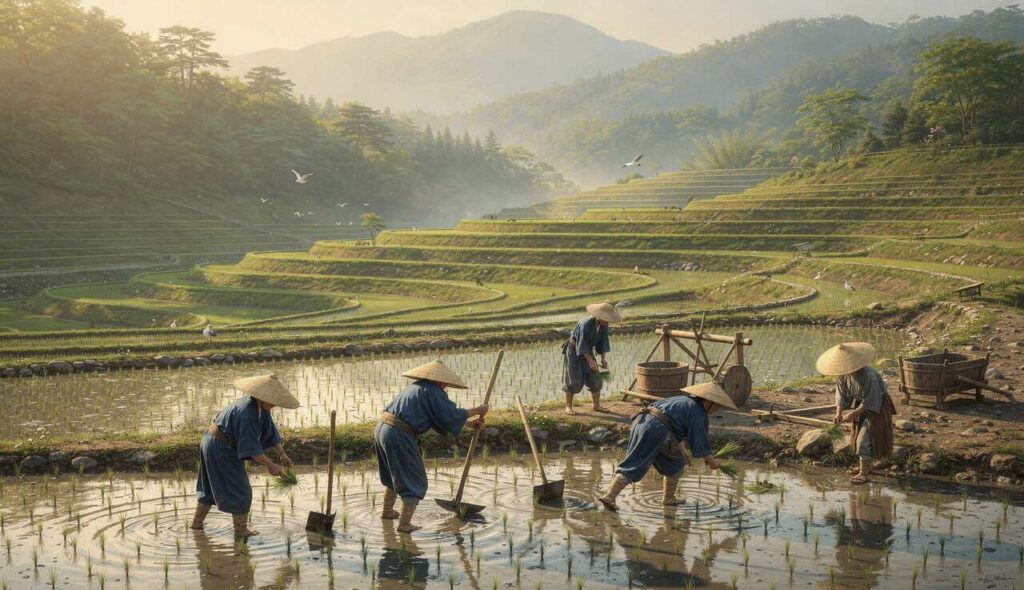
Climate uncertainty and water scarcity challenge gardeners worldwide, yet centuries ago, Japanese farmers mastered techniques to cultivate thriving crops with minimal irrigation. These ingenious methods, rooted in observation and resourcefulness, offer practical solutions for contemporary vegetable growers seeking sustainable alternatives. By understanding how traditional cultivation worked in harmony with natural processes, modern gardeners can reduce water dependency whilst improving yields and soil health.
Introduction to ancient Japanese farming methods
Japanese agriculture evolved over millennia in response to geographic constraints and variable rainfall patterns. Farmers in mountainous regions and volcanic landscapes developed cultivation systems that maximised natural moisture retention rather than relying on constant irrigation. These approaches emphasised working with environmental conditions instead of attempting to control them through water-intensive practices.
Historical context of resource-efficient cultivation
Traditional farming communities faced significant challenges: steep terrain, limited arable land, and unpredictable water availability. Rather than viewing these as insurmountable obstacles, cultivators created innovative solutions that became foundational to Japanese agricultural success. The philosophy centred on observation and adaptation, with farmers carefully studying microclimates, soil characteristics, and plant behaviours across seasons.
Key principles included:
- Minimising soil disturbance to preserve natural moisture
- Creating microclimates through strategic plant placement
- Utilising organic materials to enhance water retention
- Selecting crop varieties suited to local conditions
The philosophy behind minimal intervention
Ancient practitioners believed that nature possessed inherent wisdom requiring human facilitation rather than domination. This perspective led to cultivation methods that enhanced existing ecological processes instead of replacing them with artificial inputs. Farmers viewed themselves as stewards rather than controllers, a mindset that fundamentally shaped their technical approaches.
Understanding these foundational concepts provides essential context for appreciating the specific techniques that enabled waterless cultivation.
Waterless cultivation techniques: a revolution
The term “waterless” proves somewhat misleading, as these methods didn’t eliminate moisture entirely but rather optimised natural water cycles to reduce irrigation needs dramatically. Farmers employed several interconnected strategies that worked synergistically to maintain adequate soil moisture.
Deep mulching systems
Thick layers of organic materials formed the cornerstone of moisture conservation. Farmers applied rice straw, leaves, and plant residues in substantial quantities, creating insulating barriers that reduced evaporation whilst gradually decomposing to enrich soil. This mulch layer typically measured between 10 and 20 centimetres deep, providing multiple benefits:
| Benefit | Impact |
|---|---|
| Evaporation reduction | 70-80% decrease in moisture loss |
| Temperature regulation | 5-7°C cooler soil in summer |
| Weed suppression | 90% reduction in competing plants |
| Soil structure improvement | Enhanced porosity and drainage |
No-till practices and surface preservation
By avoiding ploughing and excessive soil disturbance, farmers maintained natural soil architecture that facilitated water movement and retention. Undisturbed soil contains networks of channels created by decomposed roots and soil organisms, which act as conduits for moisture distribution and storage. This approach contrasts sharply with conventional tillage that disrupts these systems.
These moisture-conserving techniques worked in tandem with careful attention to the growing medium itself.
The importance of soil management
Ancient Japanese farmers recognised that soil quality determined water efficiency more than any other factor. Their management practices focused on building soil structure and organic matter content, creating conditions where plants could access moisture effectively even during dry periods.
Building soil organic matter
Continuous additions of compost, green manures, and crop residues increased the soil’s water-holding capacity substantially. Organic matter acts like a sponge, absorbing and retaining moisture that remains available to plant roots. Farmers aimed for organic content exceeding 5%, compared to typical agricultural soils containing 2-3%.
Methods for enhancing organic content included:
- Incorporating cover crops between main plantings
- Composting all available plant materials on-site
- Applying aged animal manures sparingly but consistently
- Returning crop residues directly to growing areas
Creating optimal soil structure
Beyond organic content, physical soil structure profoundly influences moisture dynamics. Traditional practices promoted aggregation, where soil particles cluster together creating spaces for both water storage and air circulation. This balanced structure prevents waterlogging whilst maintaining adequate moisture reserves.
The biological inhabitants of healthy soil proved equally crucial to these cultivation systems.
The symbiotic relationship between plants and microorganisms
Japanese farmers intuitively understood that invisible soil life played essential roles in plant health and water efficiency, though they lacked modern scientific terminology to describe these processes. Their practices fostered thriving microbial communities that enhanced nutrient availability and drought resistance.
Mycorrhizal networks and water access
Fungal partnerships with plant roots extend the effective reach of moisture absorption far beyond what roots achieve alone. These mycorrhizal associations create vast underground networks that access water from greater depths and distribute it efficiently amongst connected plants. Traditional cultivation methods protected these delicate fungal threads through minimal disturbance and continuous organic inputs.
Beneficial bacteria and nutrient cycling
Diverse bacterial populations convert organic materials into plant-available nutrients whilst improving soil structure through their metabolic activities. Certain bacteria produce biofilms and polysaccharides that bind soil particles together, enhancing water retention. Farmers encouraged these populations through:
- Maintaining consistent organic matter supplies
- Avoiding synthetic chemicals that disrupt microbial communities
- Ensuring adequate but not excessive moisture levels
- Rotating crops to support diverse microbial populations
Translating these time-tested principles into contemporary practice requires thoughtful adaptation.
Adapting these techniques to our modern vegetable gardens
Home gardeners can implement core concepts from ancient Japanese farming without abandoning modern conveniences or knowledge. The key lies in integrating traditional wisdom with current understanding of plant physiology and soil science.
Starting with mulch applications
Begin by applying organic mulch layers of 7-10 centimetres around established plants, keeping material slightly away from stems to prevent rot. Suitable materials include straw, shredded leaves, grass clippings, or wood chips. Replenish as decomposition occurs, typically every 2-3 months during the growing season.
Reducing tillage gradually
Transition away from deep digging by limiting disturbance to planting holes only. For new beds, consider sheet mulching or lasagne gardening methods that build soil upwards rather than working downwards. This preserves existing soil structure whilst improving conditions over time.
Building organic matter systematically
Practical steps include:
- Composting kitchen and garden waste for regular applications
- Planting nitrogen-fixing cover crops during fallow periods
- Leaving crop residues in place after harvest
- Adding well-rotted manure or compost annually
Selecting appropriate plant varieties
Choose cultivars bred for drought tolerance or those naturally adapted to your climate. Heritage varieties often possess greater resilience than modern hybrids developed for irrigated production systems.
These practical applications deliver tangible advantages beyond water conservation alone.
Ecological and economic benefits of waterless methods
Implementing traditional Japanese cultivation techniques yields multiple rewards that extend well beyond reduced irrigation requirements. These methods create regenerative systems that improve over time rather than depleting resources.
Environmental advantages
Water conservation represents the most obvious benefit, with properly managed gardens requiring 50-70% less supplemental irrigation. Additionally, these approaches:
- Sequester carbon through increased soil organic matter
- Reduce erosion by maintaining continuous soil cover
- Support beneficial insect and wildlife populations
- Eliminate runoff pollution from synthetic fertilisers
Economic considerations
Initial investments in mulch materials and compost pay dividends through reduced input costs over subsequent seasons. Gardeners save on water bills, fertiliser purchases, and labour time previously spent on irrigation management.
| Cost factor | Traditional method | Waterless approach |
|---|---|---|
| Annual water usage | High | Reduced 50-70% |
| Fertiliser requirements | Ongoing purchases | Minimal with composting |
| Labour hours | Regular irrigation | Occasional mulch renewal |
Improved crop resilience
Plants grown in biologically active, well-structured soil demonstrate greater stress tolerance and disease resistance. Root systems develop more extensively, accessing nutrients and moisture more efficiently. This results in healthier plants producing superior yields even under challenging conditions.
Ancient Japanese farmers developed remarkably sophisticated cultivation systems that modern science continues validating. Their waterless techniques offer practical solutions for contemporary gardeners facing climate uncertainty and resource constraints. By focusing on soil health, organic matter management, and minimal disturbance, home growers can create productive gardens requiring substantially less irrigation whilst supporting ecological balance. These time-tested methods prove that sustainable abundance emerges not from controlling nature but from understanding and working within its patterns. The wisdom embedded in traditional practices provides a roadmap for resilient food production that serves both present needs and future generations.